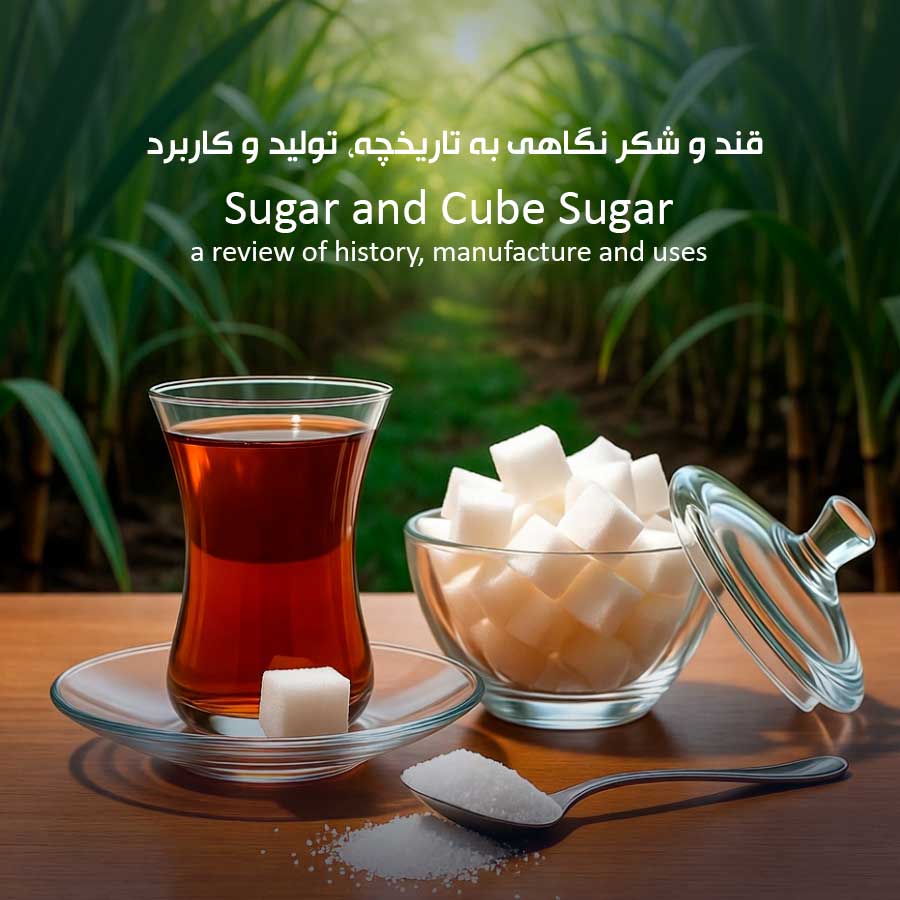
Sugar and Cube Sugar ; A Look at History, Production, and Uses
Cube sugar and granulated sugar are among the most recognized and widely consumed food items; flavorings that are present in most foods and beverages. Despite their simple appearance, behind every sugar cube or crystal lies a hidden world of processing, precision, and tradition. In this article, we delve into their production process and their role in everyday life.
From Sugarcane to Cube Sugar
The story of sugar dates back over ten thousand years; a time when humans first encountered wild sugarcane in New Guinea. However, the organized cultivation of this plant began around 350 BC in the Indian subcontinent. From there, sugar traveled a long journey to reach the land of Iran in the sixth century AD.
During the Sassanid era, Iranians were not only familiar with sugar but also developed methods for refining and purifying it. It is even said that the Chinese attribute the conversion of sugarcane syrup into solid sugar to the knowledge and experience of Iranians from that period. The word “sugar” itself is rooted in Sanskrit and the word sharkara, meaning “sweet granules,” which found its way into many other languages, including English, through Middle Iranian languages and Arabic.
In the Safavid era, sugar-making workshops flourished, and sugar transformed from a luxury good into a commercial product along the Silk Road.
But “Ghand” (cube sugar), which is derived from that very same sugar, has completely Iranian roots. In the eighth century AD, in the city of Jundishapur, Iranian scientists perfected the process of crystallizing sugarcane syrup and created solid cubes that later became known as “Ghand”. Ever since, cube sugar has become a symbol of hospitality and the sweetness of life in Iranian culture; from afternoon tea to wedding ceremonies, it has always held a special place.
From the Farm to Sweet Granules
Modern sugar is derived from two main sources: sugarcane and sugar beet. After harvesting, sugarcane stalks are crushed to extract their sweet juice. This juice is purified in several stages; first clarified with lime, then boiled and crystallized in a vacuum to form sugar crystals. Finally, by using a centrifuge and a drying process, white or brown sugar is ready for packaging.
This entire process, from the farm to the final package, takes only about two days, yet it requires high precision and strict oversight so that every sugar crystal is transparent, pure, and uniform.
Cube sugar is made from this same refined syrup, with one additional step. After crystallization, the syrup is turned into a paste, poured into special molds, and dried under pressure to take shape. The main difference between cube sugar and granulated sugar lies in the size of the crystals and its higher durability; a characteristic that makes it dissolve more slowly in the mouth, offering a milder sweetness.
Cube sugar and granulated sugar also hold an important place in the food and pharmaceutical industries. In the food industry, they are used as natural sweeteners, bulking agents, and stabilizers in products such as chocolates, biscuits, beverages, jams, and sauces. In pharmaceuticals, these two substances play a role in masking the bitter taste of medicines, increasing shelf life, and regulating the moisture of tablets and syrups.
Despite their importance in the taste and texture of foods, balanced consumption of sugar and cube sugar is essential. Both are made of sucrose and provide quick energy for the body, but excessive consumption can lead to problems such as obesity and metabolic diseases.
Shilton cube sugar and granulated sugar are meticulously sourced from the finest resources and produced under controlled processes to deliver a pure, natural, and uniform taste. Every step, from selecting raw materials to the final packaging, is carried out with the aim of preserving quality and ensuring product safety. These products are offered in various packaging and weights to meet different needs in cooking, baking, and everyday consumption. Whether for home use or industrial production, Shilton cube sugar and granulated sugar are a reliable choice for experiencing the true and authentic taste of sweetness—a taste that is simple, natural, and lasting.