Tuna Fish: Types and Characteristics
The tuna, bonito, and mackerel family includes many of the most important and familiar food fishes. This family consists of 51 species in 15 genera and two subfamilies. All species belong to the subfamily Scombridae, except for the butterfly kingfish.
Scombrids have two dorsal fins and one anal fin, and their caudal fin is stiff with a narrow base and a keel-like ridge. The first dorsal fin is spiny, and the pelvic fins are usually folded into grooves in the body. The size of species ranges from about 20 cm in island mackerels and bonito species to 4.58 meters, which has been recorded for the giant Atlantic bluefin tuna.
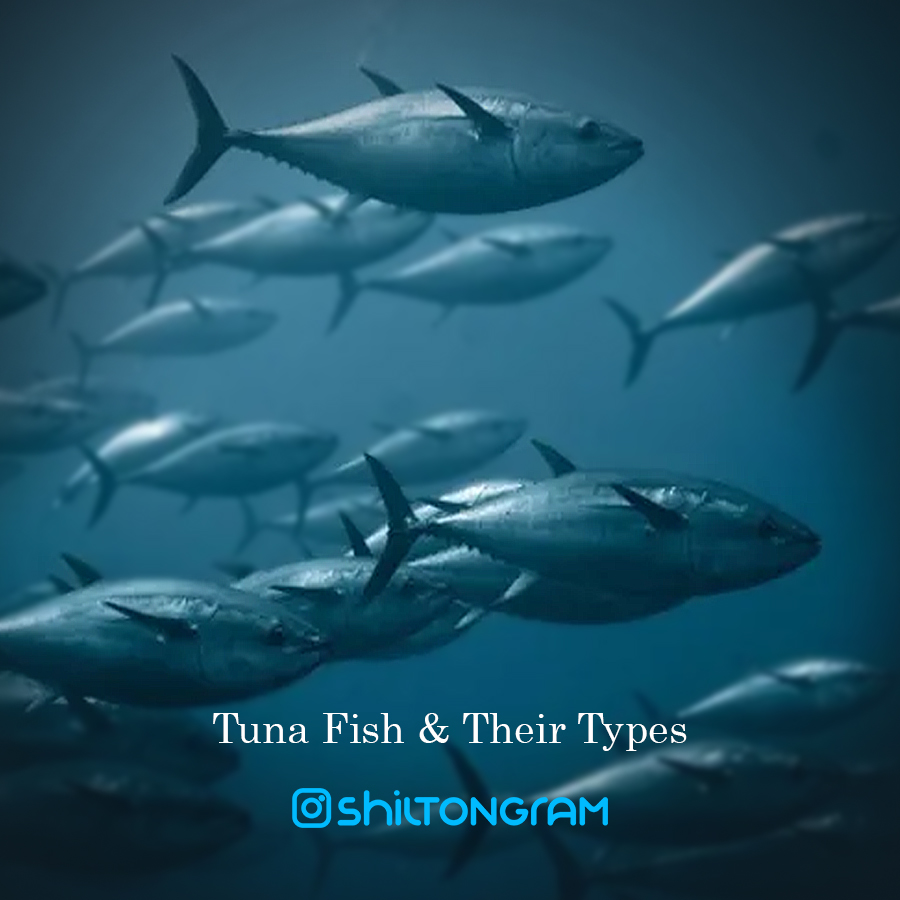
There are seven main tuna species consumed by humans, including bigeye, albacore, skipjack, yellowfin, and three species of bluefin tuna. They are found in tropical and temperate regions of all oceans. Tuna are caught from coastal waters to the open seas using purse seine nets, longlines, pole and line fishing, trolling, and gillnets.
Among them, seven major oceanic species are commercially exploited.
01 – North Atlantic Bluefin Tuna
The North Atlantic bluefin tuna is a tuna species that lives in both the western and eastern Atlantic Ocean, and its habitat extends to the Mediterranean Sea and the Black Sea. Although it is not native to the Pacific Ocean, it is also caught outside Japan.
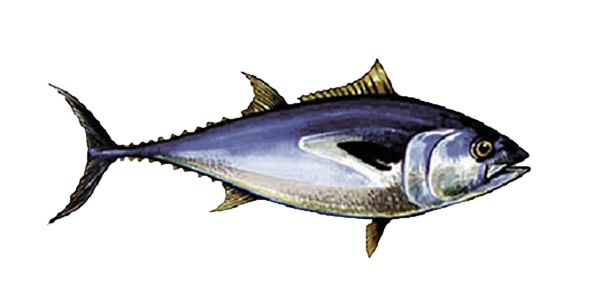
North Atlantic bluefin tuna can live up to 30 years. Their typical size is about two meters in length and around 500 kilograms in weight. The body of the North Atlantic bluefin tuna is strong and robust. This species can easily be distinguished from other members of the tuna family by its relatively short pectoral fins.
The North Atlantic bluefin tuna is an important source of seafood and provides much of the tuna used in sushi. It is considered a special delicacy in Japan, where the price of a giant tuna can exceed one hundred thousand dollars at the famous Tokyo fish market.
02 – Pacific Bluefin Tuna
According to the 2022 stock assessment, Pacific bluefin tuna is overfished, but it is not currently experiencing overfishing.
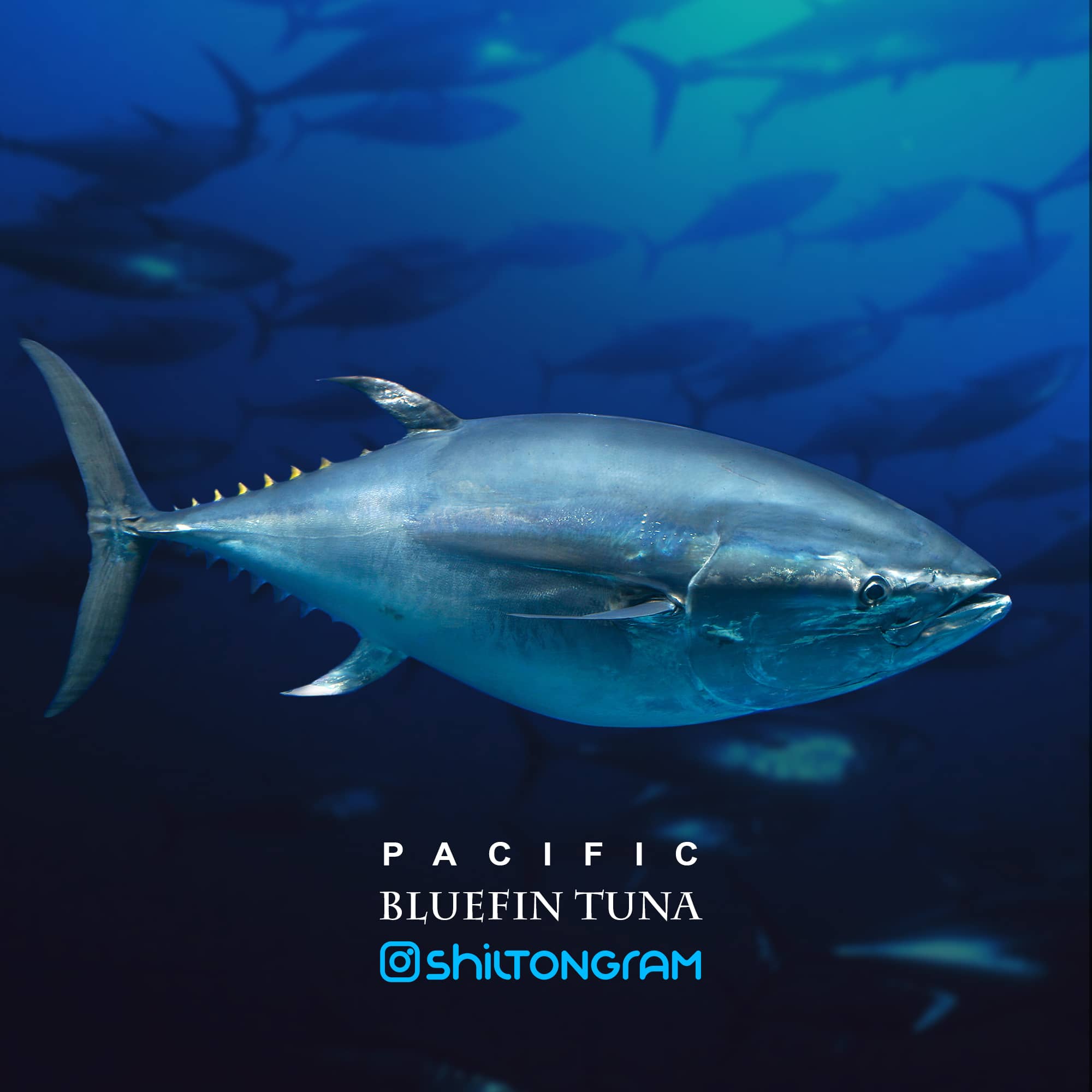
Pacific bluefin tuna have dark blue or black dorsal sides with a greenish‑gray iridescent sheen. Their belly is marked with silver or gray spots or bands. They also have a series of small yellow finlets with black edges that extend from the second dorsal fin to the tail.
A distinguishing feature of Pacific bluefin tuna is that the tips of the pectoral fins do not reach the front of the second dorsal fin. They also have relatively small eyes compared with other tuna species.
Pacific bluefin tuna reach maturity at about 5 years of age and can live up to 26 years, although their average lifespan is about 15 years. Adults are usually around 1.5 meters long and weigh about 60 kilograms, while the maximum reported size is 3 meters in length and 450 kilograms in weight.
Pacific bluefin tuna are predators and mainly feed on squid and fish such as sardines, anchovies, saury, herring, pompano, and other fish, and sometimes red crabs and krill.
Most Pacific bluefin tuna caught in the United States are taken about 100 nautical miles off the coast of California.
Pacific bluefin tuna are highly migratory and travel long distances across the Pacific Ocean. They are commonly found in temperate waters, as well as in tropical and cooler coastal regions. Among tuna species, Pacific bluefin tuna have one of the widest geographic ranges.
Tagging studies have shown that some Pacific bluefin tuna spend their entire lives in the western Pacific, while others migrate to the eastern Pacific. A trans‑Pacific journey may take about 55 days.
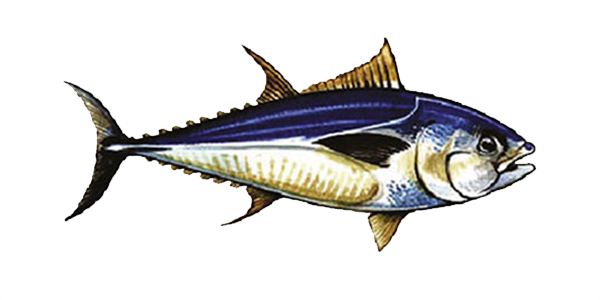
03 – Southern Bluefin Tuna
Southern bluefin tuna have a torpedo‑shaped body with a bluish‑black back and a silvery‑white belly, marked with alternating rows of distinct spots and lines. The edges of the anal fin and finlets are yellow and black, and the first dorsal fin is yellow or blue.
Their size may reach 2.45 meters in length and 260 kilograms in weight, and their lifespan is at least 40 years.
Southern bluefin tuna occur throughout the Atlantic, Pacific, and Indian Oceans. They are highly migratory and travel long distances. This marine species can be found at depths of up to 500 meters.
They feed on small fish, cephalopods, crustaceans, and salps. Southern bluefin tuna reach sexual maturity at 11–12 years of age. Spawning occurs in tropical waters during spring and summer. Only one spawning area has been identified, located in the northeastern Indian Ocean south of Java.
It is not known whether all adult fish spawn every year, every few years, or only once in their lifetime. Females produce 14–15 million eggs during the spawning season.
After spawning, southern bluefin tuna migrate southward from the spawning grounds.
Southern bluefin tuna are listed as endangered on the IUCN Red List. In Australia, they are classified as conservation dependent under the EPBC Act.
The three bluefin species occur in four main regions:
Western Atlantic Ocean
Eastern Atlantic Ocean
Mediterranean Sea
Southern Pacific Ocean
They account for only about one percent of the global tuna catch.
Bluefin tuna are considered the kings of the tuna family, famous for reaching six‑figure prices from restaurant buyers at the renowned Tsukiji fish market in Tokyo.
Bluefin tuna have a long history of fishing. They were once removed from the menus of North American and European restaurants and are now mainly found in high‑end sushi restaurants.
However, thanks to international conservation efforts, there are signs of recovery in one of the bluefin stocks in the northeastern Atlantic, giving hope that the future of this valuable fish may improve.
Many labels compete to attract consumer attention. For example, dolphin‑safe labels focus only on the impact of fishing on dolphins and do not consider overall sustainability. The best way to significantly reduce exposure to risks such as overfishing, bycatch, and illegal, unreported, and unregulated fishing is to choose tuna products with the distinctive blue MSC certification label.
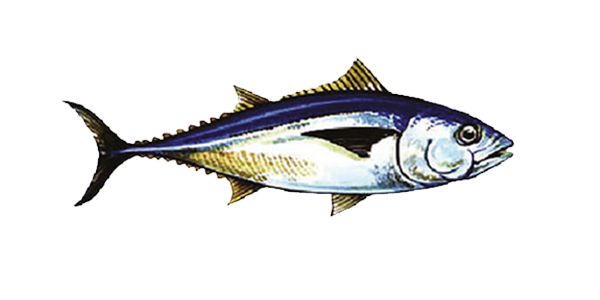
04 – Bigeye Tuna
Bigeye tuna are found in the open waters of all tropical and temperate oceans, but not in the Mediterranean Sea. Their length ranges from 60 to 250 centimeters.
Bigeye tuna are characterized by their large head and large eyes. Their pectoral fins are very long and reach the second dorsal fin, and both the dorsal and anal fins are yellow.
Bigeye tuna are an important commercial species and are usually sold fresh or frozen. They are found in the Indian, Pacific, and Atlantic Oceans and account for about eight percent of the global tuna catch.
Bigeye tuna have fattier flesh than yellowfin tuna and a richer flavor. Three global bigeye tuna stocks are considered to be in good condition, but the species is overfished in the Atlantic Ocean.
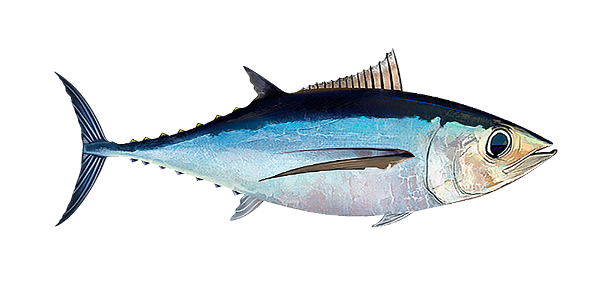
05 – Albacore Tuna
Albacore tuna are an important food fish found in the open waters of all tropical and temperate oceans as well as the Mediterranean Sea.
Their pectoral fins are very long, reaching about 30% of their total body length. They can grow up to 140 cm in length and 60 kg in weight.
Albacore is a valuable food fish, and albacore fishing has significant economic importance. Fishing methods include pole‑and‑line fishing, longline fishing, and other techniques.
The highest quality canned tuna is made from albacore. It is the only tuna species that may be classified as white meat tuna.
Albacore flesh is usually light pink to dark pink, which makes it easy to distinguish from other tuna species. Its meat is not very fatty, and it is often sold at a lower price compared with other tuna species. In fact, albacore is the only tuna that can truly be called “white tuna.”
It is usually caught in deep waters at depths of around 400 meters and is found in the Pacific, Indian, and Atlantic Oceans, the Mediterranean Sea, and even British waters.
Albacore accounts for four to five percent of the global tuna catch.
Albacore tuna with light flesh is increasingly sold in glass jars with attractive labels and metal cans with extra virgin olive oil. Its pieces are generally larger than those of skipjack tuna and have a delicate flavor with a dry, meaty texture.
It is very popular in U.S. grocery stores, where it is known as both “white tuna” and “chicken of the sea,” an old fishermen’s term derived from its light appearance and mild taste.
In Portugal and Spain, albacore is commonly known as Bonito del Norte, where it is served with piquillo peppers, mayonnaise, finely chopped onions, and a little lemon juice.
Because of its higher fat content than skipjack, albacore is also sold as fresh and frozen steaks.
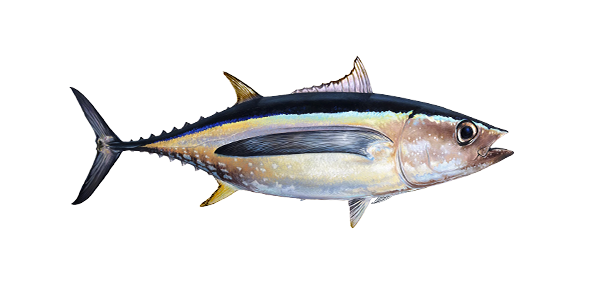
06 – Yellowfin Tuna
Yellowfin tuna, known locally as Guider, is one of the highest‑quality tuna species, living in semi‑surface waters of tropical and subtropical oceans around the world.
In southern Iran, it is also called Joodar, Gabab, or Momagh. Fishing gear used to catch it includes longlines and purse‑seine nets.
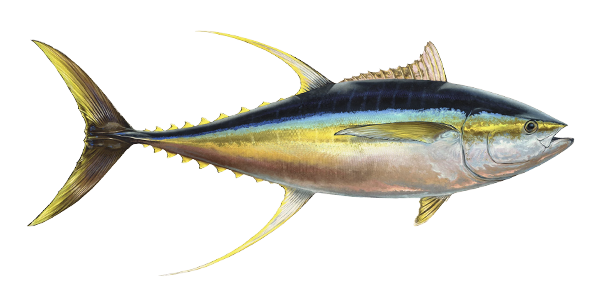
This fish has a very large body, and its most recognizable feature is the bright yellow fins and finlets located near the tail. A long dark‑blue line runs from the front of the body to near the tail.
Yellowfin tuna are found in the eastern and western Pacific Ocean, the Indian Ocean, and the Atlantic Ocean, although they are frequently observed around Australia.
Major fishing areas include Thailand, the Philippines, Indonesia, Mexico, Venezuela, Ecuador, Colombia, and Spain.
Yellowfin tuna are found throughout the Pacific, Indian, and Atlantic Oceans and account for about 29% of the global tuna catch.
More than three‑quarters of the world’s tuna catch is consumed in Japan, and yellowfin tuna is the most commonly consumed tuna in its 30,000 sushi bars.
It is also served raw or cooked in European restaurants and is the best‑selling MSC‑certified tuna in the United States.
Yellowfin tuna meat is red, leaner, and more affordable than bigeye or bluefin tuna. It often appears on menus as sashimi and nigiri.
Its medium to mild flavor makes it an excellent candidate for marinating. For example, it can be cubed and coated with soy sauce, sesame oil, and ginger, then served with avocado, edamame, and rice.
07 – Skipjack Tuna
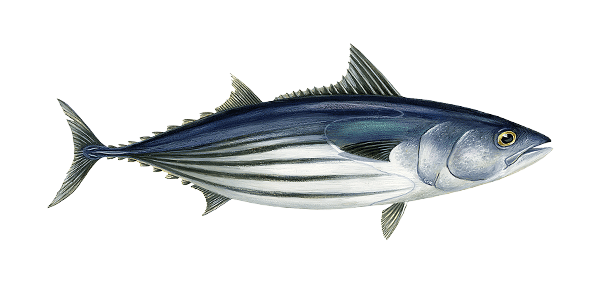
Skipjack tuna is the smallest and most abundant commercial tuna species. Their bodies are mostly scaleless, with a dark bluish‑purple back and silvery sides and belly marked by four to six dark stripes.
Skipjack tuna can live 8 to 10 years.
This species belongs to the Scombridae family and is also known by several other names, including Katsuo, Arctic bonito, oceanic bonito, striped tuna, and Victor fish.
It can reach up to one meter in length and is a cosmopolitan marine species found in tropical and warm temperate waters. It is a very important species for global fisheries.
Tuna and bonito are well adapted to long‑distance high‑speed swimming. They have torpedo‑shaped bodies and very small or absent scales that reduce drag during swimming.
Their internal structure is unique. The outer layers of the body consist of longitudinal blocks of white muscle, which allow short bursts of speed. In the center of the body there are sections of red muscle similar to those found in mammals.
This red muscle is surrounded by a network of blood vessels that regulate temperature, keeping the muscle a few degrees warmer than the surrounding water. This adaptation enables tuna to swim continuously for long periods.
Unlike most fish species that have white flesh, tuna meat ranges from pink to dark red because their muscle tissue contains higher levels of myoglobin, an oxygen‑binding molecule.
Some larger species of tuna, such as bluefin tuna, can even raise their blood temperature above the surrounding water through muscle activity, allowing them to live in cooler waters and survive in a wider range of environmental conditions.
Because tuna occupy a high position in the food chain, heavy metals can accumulate in their bodies through their diet. As a result, mercury levels may be high in larger species such as bluefin and albacore.
In the United Kingdom, skipjack, yellowfin, and albacore tuna account for about 15% of all seafood consumed, with an estimated annual sales value exceeding £300 million.
Tuna consumed in the UK comes from all oceans, and the largest exporters to the UK include Ecuador, Ghana, Mauritius, the Philippines, and Seychelles.
Skipjack tuna live in the tropical waters of the Pacific, Atlantic, and Indian Oceans. As the name suggests, skipjack often jumps above the ocean surface.
It accounts for about 58% of the global tuna catch. Its small, tender pieces are ideal for canning, and its darker, flaky flesh has a strong and distinctive fish flavor.
This makes it suitable for many foods, from packed lunches and pasta dishes to quick salads and camping meals.
Skipjack is the only tuna species that is not commonly eaten raw as sushi.
It can be enjoyed in dishes such as tuna with spring onions, pan‑fried tuna with parsley, or tuna mixed with creamy lemon mayonnaise, served with raw or grilled vegetables.
Skipjack tuna stocks are considered healthy in all ocean regions.